




















































-
Tuesday, September 29, 2009
Sunday, September 27, 2009
Thursday, September 24, 2009
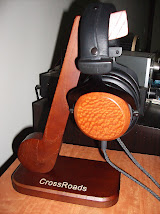
Full Size Cans: Kanen KM-880 Wooden Headphones.

Technical Data :
Driver Units: 40mm
Frequency Range: 20-20.000Hz
Sensitivity: 104 dB ( at1 KHz, 1mW )
Impedance: 32 Ohms
Cord: Single-sided (separated)
Cord Length(approx): 2.1m
Jack: 3.5mm, nickel-plated
First Impressions :
The headphone closely resembles the Targus wooden cans previously reviewed here. They come packed in a see through blister pack together with a microphone (Separate) which can be used with your computer sound card.

The Kanen KM-880 wooden headphones are a product of China and the price is ridiculous as they are being sold for US$15.50.
Right out of the box they sounded very good and I would say exceptional, exceeding the price value paid. They are great for bass head with a very extended and well controlled tight bass, no muddiness at all. The overall tonal balance was quite a surprise to me since the mid range was well balanced and the highs were nicely extended and crisp, the cohesion was good.

The plastic headband maybe a failing component later as I can foresee the plastic becoming brittle later on, but at such a low price who really cares! The wood appears to be similar to the Targus (maple???). Without any burning in these headphones sounded good out of the box and were pleasing to the ears, with furter burning they may open up even further.
I tested these using the Tsinghua University G&W TW-J1 SS headphone amplifier connected to a Sony D-NE730 discman and listened to them with only one disc that was on the study table at the time - "Mindi Abair's Come as you are", the saxophone rendition throughout Mindi's album sounded very sweet and seductive.

I did not notice any discomfort and in fact found them quiet comfortable and light. For under US$16.00, I would say go for it - you get a pair of wooden cans which sound not at all bad.

The Kanen KM-880 wooden headphones are a product of China and the price is ridiculous as they are being sold for US$15.50.
Right out of the box they sounded very good and I would say exceptional, exceeding the price value paid. They are great for bass head with a very extended and well controlled tight bass, no muddiness at all. The overall tonal balance was quite a surprise to me since the mid range was well balanced and the highs were nicely extended and crisp, the cohesion was good.

The plastic headband maybe a failing component later as I can foresee the plastic becoming brittle later on, but at such a low price who really cares! The wood appears to be similar to the Targus (maple???). Without any burning in these headphones sounded good out of the box and were pleasing to the ears, with furter burning they may open up even further.
I tested these using the Tsinghua University G&W TW-J1 SS headphone amplifier connected to a Sony D-NE730 discman and listened to them with only one disc that was on the study table at the time - "Mindi Abair's Come as you are", the saxophone rendition throughout Mindi's album sounded very sweet and seductive.

I did not notice any discomfort and in fact found them quiet comfortable and light. For under US$16.00, I would say go for it - you get a pair of wooden cans which sound not at all bad.
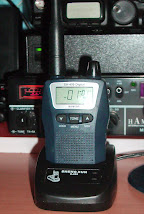
Alinco DJ-G7 Tri-band Handheld Transceiver (144MHz, 430MHz and 1.2GHz) plus General Coverage Rx.

The Alinco DJ-G7 is a Tri-band amateur radio handheld transceiver covering the 144Mhz, 430MHz and 1.2GHz bands as standard, plus it has a general coverage receiver for SW reception in AM.
It comes with it's own charging cradle powered from a wall wart transformer. Two independent VFOs, dual independent controls, up/down scanning, dual independent displays, main and sub transceiver toggling functions, call, repeater offsets, memory, scope, mode, tone, CTCSS, priority, memories, step, power output - the functions just go on and on.
It comes with it's own charging cradle powered from a wall wart transformer. Two independent VFOs, dual independent controls, up/down scanning, dual independent displays, main and sub transceiver toggling functions, call, repeater offsets, memory, scope, mode, tone, CTCSS, priority, memories, step, power output - the functions just go on and on.
 DJ-G7T/E
144MHz 5W / 430MHz 4.5W / 1200MHz 1W
FM Tri-band Handheld Transceiver
 Manufacturer's Details on the transceiver:
| Get ready for action as you hear signals that you may never have heard before. The DJ-G7 tunes 0.530-1299.995MHz continuously, and you can enjoy full duplex receive in combination with the amateur 144/430/1200MHz bands. AM and WFM modes allow you to hear the aviation and broadcast bands and with the broadcast preset memories and built-in AM bar antenna radio listening is easier than ever. Enjoy a variety of scan modes and options that include Time -set scan, 50 pair of programmable scan memories, Timing adjustable priority scanning and Alinco's patented Channel-Scope?visualize the presence of radio signals on the display. There are also two modes of bug detector functions. *Restrictions may apply to frequency combinations for Full-duplex QSO.  Customize the DJ-G7 to your personal preferences. Set the parameters to suit your needs and likes. Choose the display language (English/Japanese) lamp function and display contrast and brightness. Select Auto-Power Off / Battery save function. Turn sounds (beep, bell, end beep) on or off. Set the transmitter for VOX / TOT / BCLO. Control the DTMF burst timing, link your scan banks, set priority scan-timing and memory skip functions and more. Personalize the DJ-G7 to make it, "YOUR DJ-G7".  About IPX7 Designation The IPX7 designation provides for limited waterproofing of the radio. The specifications are immersion in one meter (approx 3ft) of still sweet water for up to 30 minutes. This compatibility is factory guaranteed for a period of one year provided all the jack covers are securely in place, any accessories connected must be genuine Alinco water-proof accessories and the radio has not been disassembled by the customer. The factory has tested and made the equipment compatible to IPX7 certification during engineering. However, please understand that this equipment is NOT certified IPX7 compliant but is designed to remain operational when used in rain, severe weather or in accidental cases of dropping it in water when used in extreme conditions and is in no way stating that you should attempt use the radio under water or submerge the radio for cleaning. Warranty will not cover radios that are water / salt damage due to negligence or misuse of the product. | |
SPECIFICATIONS
| General | |
| Frequency range: | E-version TX/RX: 144.000 - 145.995MHz / 430.000 - 439.995MHz / 1240.000 - 1299.995MHz AM/FM/TV(analog) broadcasting bands T-version TX: 144.000 - 147.995MHz / 430.000 - 449.995MHz / 1240.000 - 1299.995MHz Sub-band RX: 0.530 -1299.995MHz (Cellular frequencies 824.000 - 849.995MHz, 869.000 - 894.995MHz blocked on T-version ) |
| Modulation: | TX: F2D/F3E (RX only:WFM,AM) |
| Memory channel: | 1000 channels + 1 call channel per ham bands+50 programmed-scan pairs+100 dual-memory+100 priority+100 serch-pass |
| Antenna impedance: | 50 ohm unbalanced |
| Frequency stability: | +/- 2.5ppm |
| Supply voltage: | DC 7.4V (EBP-73 Li-Ion battery pack) / DC 4.5 - 16V (external regulated source) |
| Current consumption: (Typical value) | TX approx. 1.6A/144MHz, 1.8A/430MHz, 0.8A/1200MHz RX approx. 200mA Battery save (1:4) approx. average: Dual 56mA / Single 50mA |
| Temperature range: | -10 to +45 degrees C. (+14 to 113 F) |
| Ground: | Negative |
| Dimensions: | (WxHxD Projections exclusive): 60 x 115 x 30 mm or 2.36 x 4.53 x 1.18 in. |
| Weight: | (Antenna/EBP-73 inclusive): Approx. 296 g /9.55 oz |
| Transmitter | |
| Power output: (Approx.value) | DC13.8V: 144MHz/430MHz 5/2/1/0.3W,1200MHz 1/0.3W EBP-73: 144MHz 5/2/0.8/0.3W, 430MHz 4.5/2/0.8/0.3W, 1200MHz 1/0.3W 4 x AA cells (Max): 144MHz 2W, 430MHz 1.5W, 1200MHz 0.5W |
| Modulation: | Variable reactance |
| Spurious emission: | -60db or less |
| Max. Deviation: | +/- 5kHz |
| Mic. impedance: | 2K ohms |
| Receiver | |
| System: | Double-conversion super heterodyne (NFM,AM) Single-conversion super heterodyne (WFM) |
| Sensitivity: | 144/430MHz ham-radio bands -15dBu or better 1200MHz ham-radio band -13dBu or better Sub-band receiver (Best values): AM (10dB S/N): Lower than 50MHz -1dBu 50MHz and above -6dBu FM (12dB SINAD): 30-470MHz -15dBu 470MHz and above -7dBu WFM 76-470MHz -6dBu 470MHz and above -3dBu |
| Intermediate frequency: | Main-band FM 51.65MHz / 450KHz Sub-band AM/FM 50.75MHz / 450KHz Sub-band WFM 10.7MHz |
| Selectivity: | AM/FM -6dB 12KHz or more / -60dB 35KHz or less WFM -6dB 130KHz or more / -60dB 300KHz or less |
| AF output: | 400mW (8ohm 10%THD) |
| Specifications subject to change without notice or obligation. Specifications apply to Amateur Radio bands only. Permits required for MARS use. Product intended for use by properly licensed operators. Wide band receive related specification is for T-version only.800MHz cell-phones frequencies blocked on T version. RoHS compliant. | |
| ACCESSORIES | |
STANDARD
|
Friday, September 4, 2009
Classic Collector's Premium Communications Radio: Japan Radio Company NRD-515.

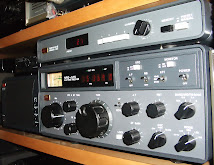
The Japan Radio Company NRD-515 is a classic collectors communications radio still held in very high regard by DX'ers and seasoned SWL'ers even today. When it was first introduced back in the 80's the basic radio was fetching US$1,200 plus (option filters, speaker etc.). Today secondhand it is still fetching well over US$1,100 a piece depending on what options and configurations come with the radio. These radios are literally snapped up as soon as they appear on the secondhand market and there is no shortage of people waiting on the waiting list to try and get one.


Yours truly is also in the fortunate position of owning one of these receivers in pristine, almost mint condition with the matching NDH-518 external memory units. I will over the course of the next two weeks or so be talking about this great receiver and what makes it so special and sought after and even today. Before I get launched in to the nitty gritty I will leave you with some photos and a video from you tube.


Yours truly is also in the fortunate position of owning one of these receivers in pristine, almost mint condition with the matching NDH-518 external memory units. I will over the course of the next two weeks or so be talking about this great receiver and what makes it so special and sought after and even today. Before I get launched in to the nitty gritty I will leave you with some photos and a video from you tube.


Background
The Japan Radio Company is a long established company since 1915 and is considered one of the oldest and largest electronics manufacturing companies in the world. Employing over 3,000 workers, JRC is a respected expert in such areas as marine radio equipment, mobile and satellite communications, fiber optics, radar, navigation equipment, and avionics systems. Therefore, it should be no surprise that JRC's line of communications receivers are held in high regard and so highly sought after for their excellent and outstanding performance, dependability, ergonomics, and ease of use.

Over the years, JRC has manufactured a fine line of consumer grade shortwave communications receivers. Beginning with the NRD*505 and ending with the NRD*545, not to mention also a fine line of amateur radio transceivers. Japan Radio Company has incorporated state-of-the-art features into a unit designed with excellent sensitivity and to be operated with ultimate user comfort. This NRD-515 is no exception and is typically sought by collectors that are fond of it's design and capabilities and exceptional performance with no compromise. According to Fred Osterman in his book "Shortwave Receivers Past and Present" the NRD-515:
"is robustly built and straight-forward to operate. This receiver remains popular with utility DXers, tropical band enthusiasts, and general shortwave listeners. The '515' has nearly a cult-like following. Clean lines, easy operation, a solid feel and outstanding performance come together in this radio."

Interestingly, the 515 sold in the late 70's thru the mid 80's for about $1,000 to $1500....a tidy sum of money in those days. Extra features such as the memory unit and additional IF filters would push the price even higher. When new models come out, typically older shortwave receivers, like most consumer products, lose much of their original value. However, the 515 in good condition is a true exception with selling prices remarkably stable even 25 to 30 years later have remained high. There are many reasons for this.

First of all, the receiver is truly built like a battleship The receiver front panel and cover are made from heavy gauge steel and designed to last. The only plastic is found are on the various knobs and feet with the balance of the receiver is all constructed of metal - no compromise, period. Even the top of the range receivers and transceivers today cannot boast this!
Secondly, the 515 was made during an era of mostly analog dial readouts that could tune to within 5 kHz or maybe even 1 kHz. However, the red LED readout of the 515 could literally tune to a resolution of 100 Hz...an achievement unparalleled by other consumer equipment from that era and almost unheard of. Only military spec. equipment could brag about such extremely high resolution tuning. Other Japan electronic manufacturers of the era were beginning to release some models with digital readouts, but again, the resolution was only as good up to about 1 kHz.
Tuning on the 515 is accomplished using a variety of knobs. The user would determine which one of 30 MHz bands they would like to tune and move the large MHz dial into that position. JRC used a optical rotary encoder that is extremely durable. Then actual tuning to the specific frequency would occur with the large right main tuning knob, or if faster tuning was desired, using the toggle tuning switch that is located at about 2 o'clock to the main tuning knob. For most tuning, this method is sufficient. However, if tuning on SSB or for RTTY, JRC also included a fine tune control that they called the delta control. This control deviates by about + or - 3 kHz and allows for extremely precise tuning.
The 515 is a extremely stable receiver. Drift after about 30 minutes of warm-up is reported to be less than 50 Hz per hour, but avid users report that they rarely have to re tune. This stability is uncustomary for this time in the consumer market and unheard of.
A nice feature found on the 515 is the pass band tuning. This control coupled with the receiver's excellent dynamic range allowed the operator to frequently eliminate considerable, if not all, of the side band interference. When used in conjunction with the optional installed filters, the 515 becomes a fantastic unit for searching out those weak signals. The choice of filters is not mode dependent and this gives the user an extra degree of flexibility in use.
General Specifications:
- Coverage from 100 kHz to 34000 kHz
- Installed filters of 6 / 2.4 / .6 / .3 kHz
- Noise blanker
- Delta Tune (RIT) of + or - 3 kHz
- BFO + or - 2 kHz
- RF gain
- AGC fast / slow / off
- UP / Down tuning
- Pass band tuning + or - 2 kHz
- S-meter
- 1/4" Headphone jack
- Ext. speaker jack
- Line out jack
- Attenuator -10 or -10 dB
- BC preselector / tune
- Mute and monitor functions for amateur radio use
Sunday, August 30, 2009
Saturday, August 29, 2009
Full Size Can: Shure SRH-840 Professional Monitoring Headphones.


Designed for professional audio engineers and musicians, the SRH840 Professional Monitoring Headphones from Shure are optimized for studio recording and critical listening. A precisely tailored frequency response and 40mm neodymium dynamic drivers combine with total comfort and durability to provide the ultimate listening experience. The replaceable cable and included set of replacement ear pads ensure a long-lasting lifetime of use. Also includes threaded 1/4" (6.3mm) gold-plated adapter.


Features (Manufacturer's hype):
- Precisely tailored frequency response delivers rich bass, clear mid-range and extended highs.
- Wide, padded headband provides ergonomic fit for superior comfort over extended periods.
- Closed-back, circumaural design rests comfortably over the ears and reduces background noise.
- Collapsible design for easy storage and portability.
- Legendary Shure quality to withstand the rigors of everyday use
- Bayonet Clip securely locks cable into ear cup.
- Replaceable ear cup pads included to ensure long product life.
- 3m (10ft) coiled detachable cable provides plenty of length and easy storage and replacement.
- Carrying bag protects headphones when on the go or not in use.
Specifications:
Transducer type
Dynamic neodymium magnet
Driver size
40 mm
Sensitivity (1kHz)
102 dB/mW
Impedance (1kHz)
44 Ω
Max. input power (1kHz)
1000 mW
Frequency range
5 Hz - 25 kHz
Net weight (without cable)
0.7 lb (317.5 g)
Shipping weight
1.75 lbs (794 g)
Length of cable
3 meters (9.84 ft)
Type of cable
Detachable coiled oxygen-free copper
Plug
Gold-plated 1/8" (3.5 mm) stereo mini jack
Un-boxing and first impressions:
The box is well designed and made and printed in English and Japanese, it appears that Shure have intentions to make an impact on the Japanese market with this product. The extra ear pads are a nice touch. The headphones come with the usual standard leatherite pouch, a detachable cable (nice touch) and the standard gold plated adapter plug. Although this is a shure product it is only designed in USA and the headphones are made in China.

The manual is multi-lingual and easy enough to understand. The build of the headphone has a solid feel and does not feel flimsy.
Listening has not been executed yet and this will be done later with my Opera Consonance Cyber-30 (2A3 tube) headphone amplifier connected to the Elekit CD player. But I have already been advised by the supplier that these headphones will require 150 hours of burn in before they reach their full potential.


The manual is multi-lingual and easy enough to understand. The build of the headphone has a solid feel and does not feel flimsy.
Listening has not been executed yet and this will be done later with my Opera Consonance Cyber-30 (2A3 tube) headphone amplifier connected to the Elekit CD player. But I have already been advised by the supplier that these headphones will require 150 hours of burn in before they reach their full potential.


Saturday, August 15, 2009
Japanese book on the story of Collins Radio Equipment
 CQ Publishing - Japanese book on the story of Collins Radio Equipment
 339 pages / 9.2 inches
Written in Japanese
Publication : 2006
I just purchased this book, although in Japanese it does have allot of photographs and circuit diagrams which are extremely useful. This is also a bit of a collectors item as it is quite rare to be found outside Japan.

Saturday, August 8, 2009
Rockwell Collins HF-80 Station
Rockwell Collins HF-80 Station Consisting of HF-8054 Receiver, HF-8010 Exciter & HF-8090 Controller. Manufactured in the 1980s. Utilised by Embassies, Armed Forces & Government Departments.
Wednesday, August 5, 2009
My Rockwell Collins "Pro Mark" KWM-380 (S/N: 926)


 I am the proud owner of a KWM-380 serial no. 926. This is a revolutionary transceiver made by Rockwell Collins some 30 years ago and is in very high demand even today on the secondhand market. They are no longer in production. Speculation on the no. of production units still exists but it is agreed that the figure is somewhere between 2,500 to 3,000 units ever to be produced. The unit price during the production day was in the region of US$6,500 a unit and they can fetch between US$2,500 to US$5,000 today secondhand dependant on the unit configuration. This is a radio that I am unlikely to part with. I am also a member of the Collins Radio Association. To the best of my knowledge this is the only Rockwell Collins KWM-380 in existence in Hong Kong.
 It has the Kiron modification and has two optional filters...the 1.7khz SSB and 360 hz CW filter. The case as you can see is in excellent condition.


Sunday, August 2, 2009
The Rockwell Collins KWM380 (One of the finest transceivers ever built).


KWM-380 SPECIFICATIONS
Parameter Specifications
Physical
Size 394 mm (15.5 in.) wide; 190 mm (7.5 in.) high,
inc. 25 mm (1 in.) feet; 457 mm (18.0 in.) deep.
Weight 27.2 kg (50 Lb.), max
Environmental
Operating temperature 0 to 50øC (32 to 122øF)
Operating humidity 0 to 90% relative humidity
Operating altitude 0 to 3049 m (0 to 10,000 ft.)
Vibration 2 g's, 10 to 33 Hz
Electrical
Primary power Strappable for: 105,115,125/210, 220, 230, 240,
250 V + 5%, 50 to 60 Hz; or 12 to 15 V dc,
negative ground:120 watts max in receive,
600 watts max in transmit
Receiver
Frequency 0.5 to 30.0 MHz, tunable in 10 Hz steps
Modes u.s.b., l.s.b., a.m..and c.w.
Sensitivity (Soft uV 0.5 pV or better for 10 dB (s+n)/n, 2.0 to 30.0 MHz,
measurement) s.s.b. and c.w.; 1.0 uV or better for 1.8 to 2.0 MHz.
Selectivity (3 dB Selectable:
bandwidth) 8 kHz *1.7 kHz
*6 kHz *360 Hz
2.1 kHz *140 Hz
*Optional Filters
I.F. and image rej Greater than 60 dB
Intermod distortion -50 dB or better for two signals of -10 db mW each,
20 kHz apart
AGC Audio output variation not more than 8 dB for 4 uV to
200 mV open circuit r.f. input variation
Audio output Not less than 3 W into 4 ohm load, at 1 kHz, at not
more than 10% total harmonic distortion
Line audio output not less than -10 dB mW nominal in
to 600 ohms
Frequency response: 300 to 2400 Hz with not more than
5 dB variation
Transmitter
Frequency 160 through 10 m amateur bands, in 10 Hz steps
160 m 1.800 to 2.000 MHz
80/75 m 3.500 to 4.000 MHz
40 m 7.000 to 7.300 MHz
20 m 14.000 to 14.350 MHz
15 m 21.000 to 21.450 MHz
10 m 28.000 to 29.700 MHz
Modes u.s.b., l.s.b., and c w. (RTTY by AFSK on l.s.b.)
Output power 90 W pep, min (100 W, nominal)
In c.w. or RTTY: 50% duty cycle; key down 15 minutes,
max. Automatic turndown to 50 W after 10 seconds.
With optional blower kit installed, power is 100 W
average, 50% duty cycle, key down 1 hour max at 25øC;
30 minutes max at 50ø C for all modes.
Unwanted sig suppression
Carrier -50 dB or better
Undesired sideband,
1 kHz ref -55 dB or better
Harmonics (all) -40 dB or better
Mixer products -50 dB or better
Third order distortion 25 dB below each tone of 2-tone test
Synthesizer accuracy Accuracy within + 5 Hz after 10 minutes warmup when
and stability 39.6 MHz and 455 kHz oscillators are set to within
+/- 3 Hz.
Stability within +150 Hz over temperature range of 0
to 50øC (32 to 122øF) if oscillator's set within
10 Hz at 25 øC (77 øF)
Antenna Impedance 50 ohms, nonreactive. (Full transmitter power output
with v.s.w.r. of 2:1 or less. Automatic power output
turndown with v.s.w.r. greater than 2:1.)
Audio inputs
Microphone Low or high impedance, dynamic; 3.3k nominal
impedance
Line 600 ohm, unbalanced; 40 mV input sufficient for full
r.f. power output
Subscribe to:
Posts (Atom)